Meet the visionaries – in the real estate industry
·
Wermlands Invest
Customer interview: Wermlands Invest makes it easier to be a tenant
Wermlands Invest in Karlstad, Sweden, brings information, services and communication with its tenants together in one place – with Avy, integrated with its property system Vitec and the tenant survey tool AktivBo, and with the AI agent Davy.
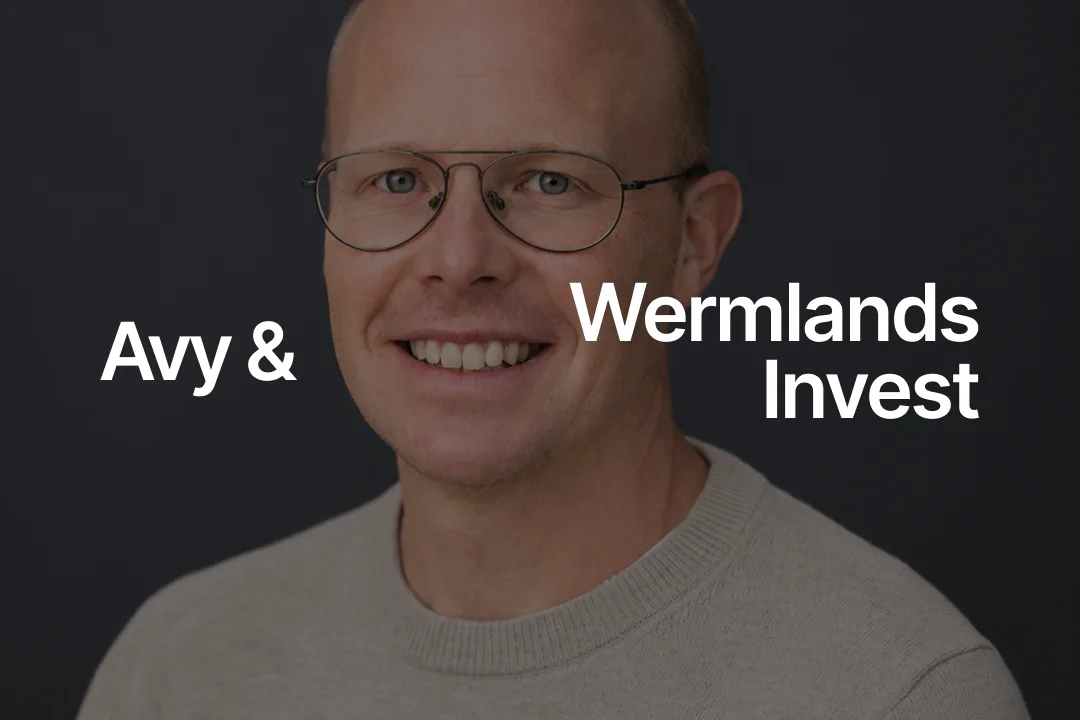
“Ultimately, it’s about making the living experience better, not about the technology itself.”
1. Needs and choice of solution
What need made you look for a digital platform for tenants and property management?
The biggest need was to improve communication with our tenants. We lacked a single digital platform where tenants could easily find information, manage their matters and follow their service requests.
At the same time, we were working in several different systems, which made the experience fragmented for both tenants and employees. We wanted to bring information, services and communication together under one roof – a modern, accessible channel where tenants can handle more matters digitally themselves, and where we are better placed to provide fast, clear service.
You had several options on the table – what ultimately pointed towards Avy?
Among other options, we evaluated Vitec Mina Sidor (the tenant portal from our property system provider) and other alternatives on the market. What spoke most in Avy’s favor was the modern, user-friendly interface. The platform had to be easy to use, both for our tenants and for our employees.
Another important factor was that Avy already had ready-made integrations with several of the systems we use. We also saw great potential in the AI agent Davy from the very start.
What perhaps stood out the most was Avy’s pace of development and focus on the future. In an industry that can sometimes be rather slow-moving, we felt that Avy drives development forward, listens to its customers and continuously improves the product. That fits well with our own ambition to offer a modern, future-proof living experience.
As a local company in Karlstad, being close to your tenants matters. How does the platform help you with that?
We don’t see the digital platform as a replacement for personal contact, but as a complement to it. That is why we have kept our traditional contact channels while building up a modern digital channel.
Our ambition is for the app to be so simple and smooth that it becomes the natural first choice for many matters. There, tenants can find information, follow their service requests and manage different parts of their home whenever it suits them.
For us, digitalization is not about creating distance – quite the opposite. It’s about making it easier to get in touch with us. The app should become the natural way in, while personal contact remains where it adds the most value.
2. Implementation and use
What has the journey looked like since you started with Avy – and what has mattered most to get it right?
The most important thing has been the close collaboration with the Avy team. We have had dedicated people to work with throughout the process, and it was a big advantage that they already had experience of the Vitec integration.
We also spent a lot of time quality-assuring data and testing before the launch. In fact, we chose to push the launch back slightly to make sure everything worked. For us, launching with high quality was more important than keeping to an exact timeline.
A large part of the work has revolved around the AI agent Davy, where we have built up and quality-assured the content the AI works with. At times it has been challenging to tell whether certain answers were down to our content, the underlying AI model or the settings in the platform. At the same time, we see it as a long-term investment: the knowledge and data we are building today will keep creating value as the AI capabilities develop.
You have connected the platform to Vitec and AktivBo. What has that meant for your day-to-day work?
The integrations have made a big difference, both for our tenants and for us as an organization.
One feature we particularly appreciate is that tenants can answer AktivBo surveys directly in the app. The threshold for giving feedback should be as low as possible, since a high response rate gives us a better basis for understanding our tenants’ needs.
The integration with Vitec, our property system, has also made a big difference. A large share of the tenants who used to send service requests by email now use the app instead. They can follow their requests themselves and see the current status, which gives better transparency, reduces the need to contact us for updates and gives us more structured case management.
As with most integrations, there are also challenges. Today, tenants cannot report faults in shared areas in the way we would like. We have found a workable solution, but it requires some manual handling. On the whole, the integrations have brought more processes together in one shared flow – a better experience for our tenants and a more efficient way of working for us.
What have tenants said about the platform so far – and what has surprised you?
What is used most are the services and integrations connected to the platform. Laundry room booking, remote door opening and the ability to track water consumption have been well received and are actively used.
We have been pleasantly surprised by the high adoption rate. Many tenants have downloaded the app and use it regularly, which shows that interest in digital services is high when they create real value in everyday life.
As for Davy, we don’t yet see extensive use, but the number of questions is gradually increasing as more tenants discover the option.
One challenge that has surprised us is that many tenants still miss the information we send out. That is why we welcome the latest platform updates, which make it clearer when there is new information to read.
3. Future and further development
What do you hope tenants will notice – in their everyday lives, not in the technology?
Most important is that tenants feel it is easier to be our customer. We hope they notice clearer communication and that we are more available, even outside our regular phone and office hours.
Instead of logging in to several different systems, tenants should be able to manage large parts of their home in one place: find information, follow their requests and get in touch with us when needed. Ultimately, it’s about making the living experience better, not about the technology itself.
What are your long-term expectations of working in an AI-driven platform?
We see AI as an important part of the property management of the future, but above all as a tool for improving service. AI should be able to answer questions faster, make information more accessible and provide support with the recurring questions of everyday life.
At the same time, AI is a complement to our employees, not a replacement. By automating simpler matters, we free up time for the questions where human contact creates the most value.
In the longer term, we believe AI will contribute to more proactive property management, where tenants get faster help, better information and greater availability – and where we can focus on developing the living experience.
Looking five years ahead – what does digital property management look like then, and what will it take to get there?
In five years, we believe AI will be a natural part of many touchpoints between tenant and property owner – not only in apps and chats, but also on the switchboard, in email and in other channels. Tenants should be able to get quick help at any time of day.
Human contact will remain important. AI takes the simpler, recurring questions, while matters that require advice, understanding or personal support are handled by our employees. For us, it’s about striking a balance where we benefit from new technology without losing the personal, accessible feel that our tenants appreciate.
To get there, the industry needs to keep moving towards more open systems and better integration options. We hope more suppliers see the value of open APIs and standardized integrations, so that different systems can work together without unnecessary limitations or lock-in.
