Blog
·
8
Min read
Case management for property managers
Case management, tenant communication and the digital customer journey in one system – and how AI resolves more than half of all cases without manual handling.
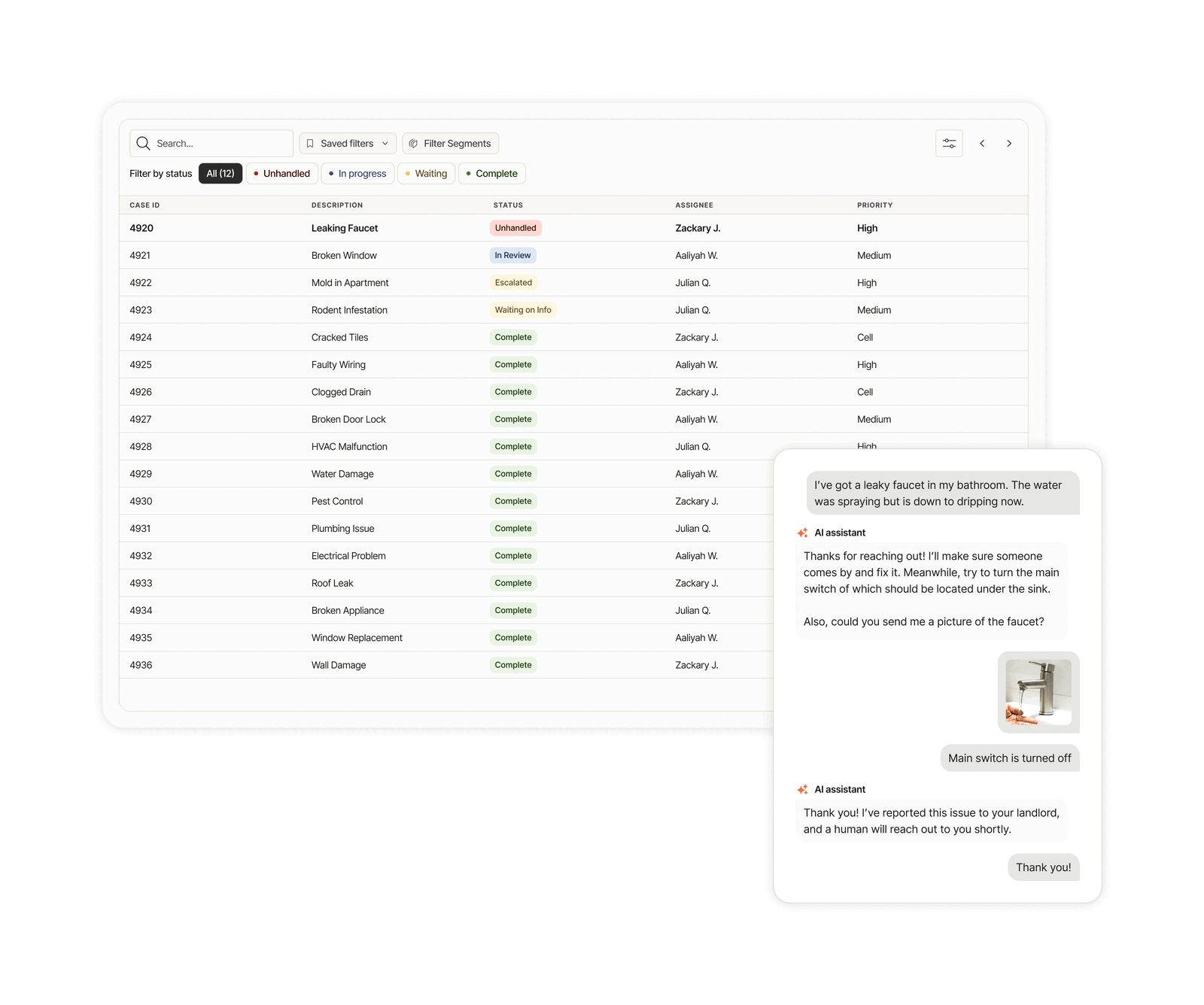
Case management is a core part of modern property management. Maintenance requests, questions about rent invoices, parking, contracts, bookings and move-ins are just a few examples of the hundreds of types of contact a property company handles. But good case management is not simply about logging a case and marking it as closed.
For property companies it is about understanding who the tenant is, what has happened before, what has already been communicated and what the next step should be. That is why the boundaries between case management tools, CRM, customer service and communication tools are dissolving.
With Avy Tenant Management, case management, tenant communication and the digital customer journey live in the same system – one platform built specifically for the property industry and for the relationship between the property company and the tenant.
Short summary
- Case management in property management means receiving, categorising, prioritising, handling and following up questions and service requests from tenants.
- For most property companies the challenge is not creating tickets, but that the tenant relationship is spread across the property management system, a case management tool, a CRM, email and communication tools.
- Tenant Management brings case management, tenant communication and the digital customer journey into one and the same system – with customer data, customer service and AI in the same context.
- An apartment generates on average around six general cases and two maintenance requests per year. More than half of the general cases can be resolved without manual handling, through self-service and AI agents.
- Avy does not replace your property management system – it complements it with a layer built around the tenant.
What case management covers
Case management in property management is the process of receiving, categorising, prioritising, handling and following up questions and service requests from tenants and residents. It typically includes:
- maintenance requests and service issues
- questions about rent and payments
- questions ahead of move-in and move-out
- parking and garages
- bookings
- questions about contracts and the home
- disturbance and nuisance reports
- customer service enquiries
- general communication between tenant and property company
The volumes are larger than most people assume. Avy's data shows that an apartment generates on average around six general cases and two maintenance requests per year. For a company with ten thousand apartments that adds up to eighty thousand contacts annually – and the vast majority are questions rather than faults that need a technician.
A modern case management system therefore needs to do more than create tickets. It needs to help the property company build a coherent picture of the entire tenant relationship.
The problem: the tenant relationship is spread across systems
Many property companies have invested heavily in digitalisation. Even so, customer service and property teams often work in several parallel systems: the property management system holds information about the property, contracts and units, a separate case management tool handles maintenance requests, a CRM holds customer information, a communication tool is used for outbound messages – and email lives somewhere else entirely.
For the employee that means more systems to switch between. For the tenant it can mean giving the same information more than once, or struggling to see where a case actually stands. And for the organisation it becomes harder to see the full picture of the customer relationship. This is exactly what Avy Tenant Management is built to change.
CRM, case management – or Tenant Management?
A traditional CRM helps companies gather information about their customers and manage customer relationships. The challenge is that general-purpose CRMs are not built around the processes of the property industry, and that a tenant relationship does not behave like a traditional customer relationship. The tenant has a contract tied to a specific unit, the relationship can run for many years, and it involves recurring payments, service requests, tenant communication, bookings, documents and a wide range of contacts with the property company.
A traditional case management tool solves a different part of the problem: receiving, assigning and closing cases. Avy starts from the whole tenant relationship instead – which is why we talk about Tenant Management.
You could describe Tenant Management as a CRM for the property industry, but the concept covers more than that. At its core, case management, tenant communication and the digital customer journey sit in one system instead of three. Around that core you find customer data, AI and automation and connections to the property management system. Instead of treating every touchpoint as a separate process, the property company can build a coherent digital relationship with the tenant – from the first move-in question to the day they hand back the keys.
Why Avy differs from traditional case management tools
Plenty of systems can log a case. Avy sets out to do more than that.
1. Built for the tenant relationship
Generic CRM and case management systems have to be adapted to how the property industry works. Avy is built specifically for property companies and starts from the processes and conversations that arise between landlord and tenant. That means case management is not an isolated function, but part of the entire digital tenant journey – from move-in to move-out.
2. Case, communication and customer journey
A case is almost always made of communication. The tenant asks a question, customer service may need to request more information, a property manager takes over, the status changes and the tenant needs an update. When case management and communication tools are separated, information gaps and extra admin follow easily.
With Avy, customer data, communication and cases connect inside the same tenant app the resident already uses to pay rent, book the laundry room and read updates from the company. The case becomes a natural part of the customer journey rather than a separate track – easier for the employee to understand the history, and easier for the tenant to get relevant information.
3. AI that does the work – not just answers
AI can do considerably more for property companies than draft replies in a chatbot. Avy's AI agent Davy is built specifically for customer conversations in the property industry and can help before a case ever reaches an employee – by understanding what the tenant needs help with, asking relevant follow-up questions, guiding them to the right information, collecting the right details, categorising and structuring incoming cases, creating cases automatically and handing over when human help is needed.
This is where the volumes get interesting. Of the six general cases per apartment per year, more than half can be resolved entirely without manual handling. Some disappear through good self-service – the tenant finds the answer in the app and never needs to create a case at all. The AI agent takes ownership of the rest end to end, and brings in a human only when the case genuinely calls for one. Maintenance requests more often need a technician, but even there the AI can gather the right details up front so the visit gets it right the first time.
AI is therefore not a separate layer alongside case management, but an active part of the workflow itself. The result is that more questions can be resolved immediately, while the cases that do need human handling arrive with better information from the start.
From reactive to proactive case management
Traditional case management is fundamentally reactive: a problem occurs, the tenant contacts customer service, a case is created, someone handles it. When customer data, communication, case history and AI are connected, a more proactive way of working becomes possible.
The property company gets a clearer view of which questions keep recurring, where in the customer journey problems arise and what information tenants are often missing. That creates the conditions to fix the cause of recurring questions rather than just managing the consequence. After all, the best case management is sometimes the case that never has to be created.
Two perspectives, one system
Case management should not only be optimised for the person working inside the system – it also has to work for the person on the other side. The tenant should easily find information, get help, create a case and understand what happens next, and communication should be relevant and accessible without the resident needing to understand the property company's internal system landscape.
At the same time, the employee needs the right information and the right tools to deliver fast service. When both perspectives meet, the result is both more efficient property management and a better tenant experience – and that experience is what the tenant remembers when it is time to renew the lease.
Does Avy have to replace your property management system?
No. Avy is not built to replace the core functions of your property management system – that system remains central to properties, units, contracts and other management processes. Avy complements your existing environment with a layer built around the tenant and the tenant relationship.
Through integrations, information and processes can be connected, while tenants and employees get a more modern interface for service, communication and case management. Property companies do not have to choose between their existing property management system and a modern customer experience. They can have both.
Six questions to ask when evaluating systems
When a property company evaluates a new case management system, the question should not just be "can the system handle our cases?". Some more important questions are:
- Is the system built for the property industry? The better the system understands the industry's processes, the less the business has to adapt itself to a generic tool.
- Do case, communication and customer journey hang together? The tenant should meet one coherent experience, not three separate systems that happen to belong to the same landlord.
- Can cases be connected to a complete picture of the tenant? A single case rarely tells the whole story – history and context make it easier to give relevant service.
- Can the system integrate with your existing property management system? A modern tool should complement your IT environment rather than create yet another information silo.
- Can the AI actually do work? There is a big difference between AI that only generates text and AI that can resolve a case end to end and escalate only when needed.
- How many cases disappear entirely? Ask for the share resolved through self-service and automation – that is the number that decides how much time you actually free up.
Why Avy is an alternative to traditional case management and CRM
For property companies that only want to log and assign tickets, there are plenty of general-purpose case management tools. But the tenant relationship is bigger than a single case. That is why Avy combines case management, tenant communication, the digital customer journey, CRM-like customer data and AI in one ecosystem built for the property industry.
The goal is not just to help property companies handle more cases faster. The goal is fewer unnecessary cases, better information in the cases that genuinely need handling, and a more coherent relationship between the property company and the tenant. That is the next step from traditional case management to Tenant Management.
Frequently asked questions
What is the difference between CRM and case management?
A CRM focuses on the customer relationship and information about the customer, while a traditional case management system focuses on individual questions or tickets. For property companies there is real value in combining the two perspectives, so that every case can be understood in the context of the whole tenant relationship.
How much of case management can be automated?
An apartment generates on average around six general cases and two maintenance requests per year. More than half of the general cases can be resolved entirely without manual handling – partly through self-service where the tenant finds the answer themselves, partly through AI agents that take the case end to end and escalate to a human only when it is genuinely needed.
Can Avy integrate with existing property management systems?
Yes. Through integrations, property data and processes can be connected to Avy's interface for tenant experience, communication and case management.
Ready to take the next step in case management?
Avy Tenant Management helps property companies bring case management, tenant communication, the digital customer journey and AI together in one platform built for the relationship between the property company and the tenant. The result is fewer cases to handle, simpler workflows for employees and a more coherent experience for residents.
Want to see how Avy's case management works in practice? Book a demo with us.