Blog
·
8
Min read
Tenant portal, tenant app or tenant platform?
Tenant portal, tenant app or tenant platform? How they differ – and what housing companies should require when the property management system is replaced.
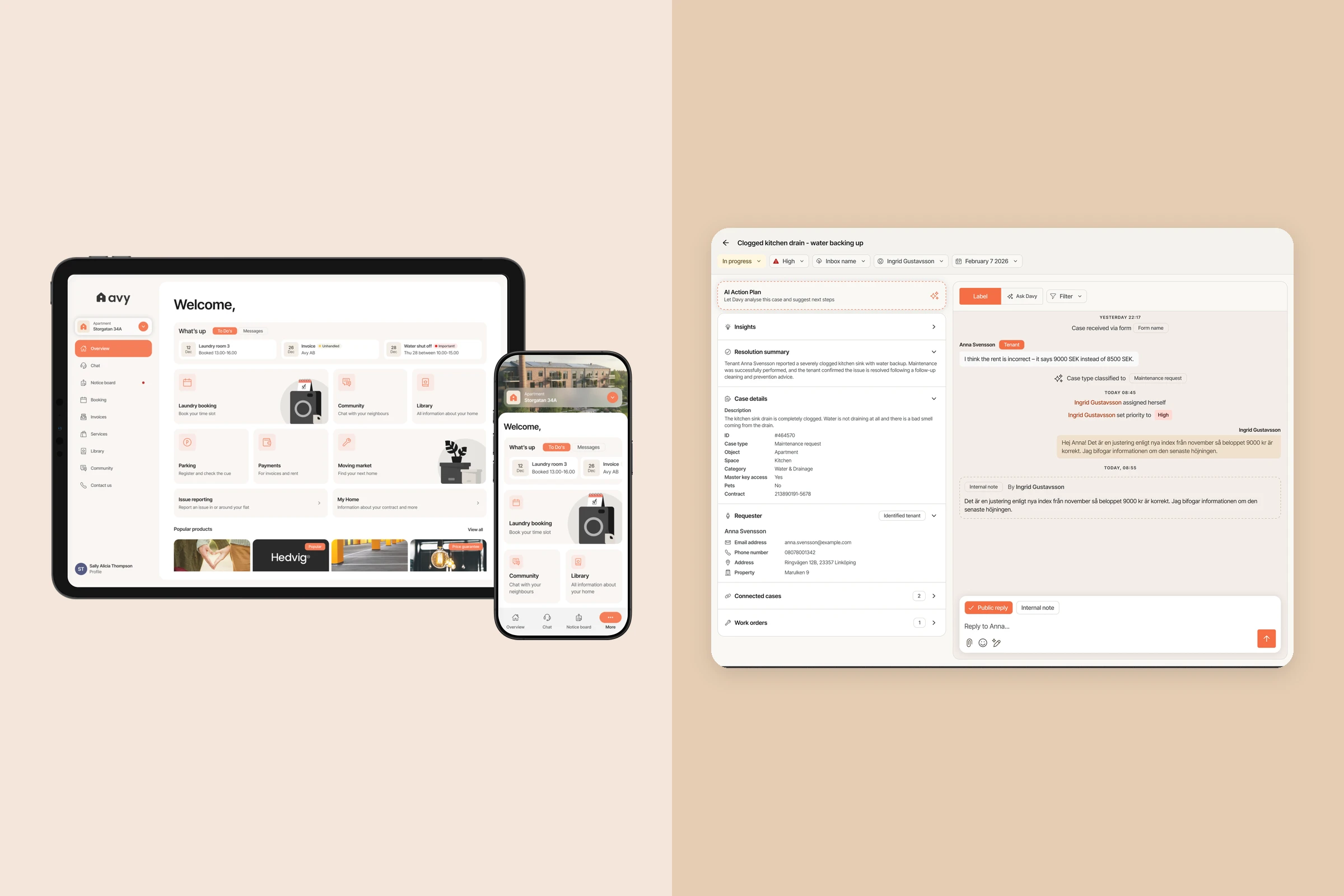
Most housing companies already have a tenant portal. Yet tenants keep calling. They call to ask when the water will be shut off, where to find the rent invoice, how to book the laundry room or how the maintenance request they sent last week is progressing. At many companies, the vast majority of all customer contacts still come in by phone and email, even though a digital channel exists.
That is why the question of tenant portal, tenant app or tenant platform is high on the agenda, often when the property management system is about to be replaced or procured again. But the question tends to be asked about the surface: should tenants log in through the browser or through an app? What decides whether the digital channel is actually used is what tenants can do there – and whether it works all the way through. Everything about their home needs to be in one place: news and service updates, contracts and invoices, bookings, move-in and move-out, community, services and requests they can follow.
This article explains the difference between the three concepts, why low digital adoption is rarely an interface problem, and what you should require of a solution regardless of which property management system sits underneath.
Summary
- A tenant portal is usually a web portal included in the property management system, showing contracts, rent invoices and maintenance requests.
- A tenant app is a mobile interface for tenants with push notifications, bookings, news and maintenance requests with photos.
- A tenant platform brings app, web, communication, community, case management and AI together in one system on top of the property management system.
- Low digital adoption is rarely caused by the channel itself, but by it covering only part of the tenant's home life: information is scattered and requests lack status and feedback.
- A tenant platform can stay in place when the property management system is replaced, so the tenant experience does not have to be rebuilt from scratch.
Portal, app and platform – the difference
The terms are often used as synonyms, but they describe different things. The tenant portal and the tenant app are channels – what the tenant sees. A tenant platform is what sits behind the channels and decides what happens to the information.
- Tenant portal: a web portal, often a module in the property management system. Tenants log in with a secure digital ID and see their contract, their rent invoices and can submit a maintenance request.
- Tenant app: a mobile app in the housing company's own brand. It offers push notifications, booking of laundry rooms and shared spaces, news per property and maintenance requests with photos.
- Tenant platform: the whole. App and web for tenants, case management and communication tools for staff, insight into what tenants do and how satisfied they are – and AI that handles the most common questions.
The boundaries are fluid, and it shows in procurements. A tender document may be titled "mobile application for tenants", but the requirements are about secure login, integration with the property management system, request status, targeted news per stairwell and bookable resources. Those are platform requirements, even when the word app is on the cover.
What a tenant platform should bring together
- Communication: notice board, targeted news and service disruptions per property or stairwell, push notifications and surveys.
- Community: a place where neighbours can talk to each other, organise shared activities and help one another.
- My home: contract, rent invoices with payment status, documents and property information.
- Booking: laundry room and shared spaces.
- Move-in and move-out: guided flows that take tenants through the move step by step.
- Tenant services: electricity, broadband and home insurance directly in the platform.
- Help and requests: help centre with AI answers, chat with the property team and maintenance requests with status.
Each part removes a reason to call, and for the company the same platform provides tenant insights: how the platform is used, what tenants think and where questions arise. But it is usually the requests that decide trust – if a maintenance request disappears into a black hole, it matters less how well everything else works.
Why tenants still call
A common pattern looks like this. Information about the home is scattered: news on the notice board and the website, invoices in the tenant portal, the laundry room in a separate booking system and maintenance requests in a form. Tenants don't know where to look, so the easiest thing is to call. At the same time, self-service has sometimes produced incomplete maintenance requests – wrong category, no photo, unclear whether there are pets – and customer service has come to prefer the phone.
From the tenant's side it looks different. The maintenance request was sent, but then nothing visible happened. No status, no feedback. Calling to ask how it is going is then perfectly reasonable – and that very type of call is among the most common in many customer service teams. The problem is not that the channel is a web page instead of an app. The problem is that the channel covers only part of the tenant's home life and is not connected to the flows behind it.
Portal, app – or a tenant platform?
A tenant portal inside the property management system has real advantages. The data is already there, no extra integration is needed and the module is often included in the licence. The downside is that it can rarely be adapted, either visually or functionally, and that it follows the property management system's pace of development. When the system is replaced, so are the tenant's login, interface and habits.
A standalone tenant app often provides a better mobile experience. But if the app only displays information and forwards forms, it becomes yet another channel to keep track of, not a replacement for the others.
A tenant platform instead starts from the entire customer relationship. Tenants get the same tenant experience in app and web. Requests land in case management built for property companies, with a status the tenant can follow. News and service updates go out as targeted tenant communication per area, property or stairwell. And AI agents handle the questions that would otherwise become phone calls.
What makes Avy different
Avy is the customer platform for the property industry and is used today for more than 500,000 homes. Four things set it apart from a portal or an app.
1. Everything about the home in one place
Communication, community, invoices, bookings, move-in and move-out, services and requests in the same app and web, connected to the property management system. Tenants don't need to know which system does what.
2. The request goes all the way
A maintenance request in Avy becomes a case with status, dialogue and history – and it can be passed on to the property management system where the maintenance team works. Tenants can see whether the case has been received, started or closed, and can answer questions in the same thread. That removes the reason for the "how is my request going?" call.
3. AI that asks the right follow-up questions
The most common objection to self-service is the quality of the requests. Avy's AI agent Davy asks the follow-up questions an experienced customer service agent would have asked – where in the apartment, what type of fault, are there pets – and resolves simple questions directly, around the clock. At SGS Studentbostäder, this has led to 70 percent fewer emails and 50 percent fewer calls.
4. Your brand, not ours
Tenants meet the housing company, not Avy. The app and web are adapted to the company's visual identity, and the company chooses which terms are used – maintenance request or service request, caretaker or customer host.
When the property system is replaced
Right now, many housing companies face a choice. Modules are discontinued, systems are migrated and procurements begin. The question then becomes whether to choose an all-in-one solution from a single vendor or to combine the best system for each part.
The all-in-one solution means fewer vendors and a single contract. The combined route gives greater freedom, but requires clear integrations and a clear division of responsibilities. The most important advice from companies that have made the journey is to decide which system owns what before the project starts. A tenant platform on top of the property management system means the tenant experience can stay the same even if the system underneath is replaced – provided the platform has integrations with the common property management systems.
Six questions before you procure
- How do tenants log in? Secure digital ID is standard, but also check how co-residents are invited and what happens when the contract ends.
- Can tenants follow their request? Status and dialogue in the case are what reduce follow-up calls the most.
- Where does the request end up? A digital request that has to be retyped manually into the property management system saves no time.
- Who decides the terminology? Tenants should recognise the company's language, not the vendor's.
- What happens if you change systems? Ask how the solution is affected if the property management system is replaced in a few years.
- How will you measure the effect? The share of digital requests and the number of calls are simple, clear metrics to set targets for.
Frequently asked questions
What is the difference between a tenant portal and a tenant app?
A tenant portal is usually a web portal included in the property management system, where tenants see their contract and rent invoices and can submit maintenance requests. A tenant app is a mobile interface with features such as push notifications, bookings and targeted news. Both are channels. What tenants actually get out of them depends on the case management and integrations behind them.
Do we need to replace our property system to get a tenant platform?
No. A tenant platform like Avy sits on top of the property management system and retrieves contracts, units and invoices through integration. The property management system remains the source for finance and contracts, while the platform handles the customer relationship. This also means the platform can stay in place if the property management system is replaced.
How can AI increase the share of digital requests?
AI can answer common questions directly and ask follow-up questions when a tenant submits a maintenance request, so the request is complete from the start. That removes the most common reason for preferring the phone, namely that digital requests end up incomplete. At the same time, tenants can get help around the clock, including outside office hours.
Ready to take the next step?
Avy brings tenant app, web, case management, communication and AI together in one customer platform that works on top of your existing property management system. The platform is used by both private property owners and public housing companies.
Book a demo and we will show you what it could look like for you.